The Postcard Before the Screenshot
The postcard made a distant view portable: see how its image, caption and journey shaped what a recipient could know about a place.
How did a postcard make a distant place feel close without showing everything? The postcard turned a selected view into a portable image and message: one person chose what to send, another encountered that choice somewhere else. Its small frame carried not simply a scene, but a way of looking at the scene.
To see how that worked, follow an invented postcard from a visitor in a coastal town to a friend at home. The imagined journey shows how a picture becomes a shared reference, how a few lines steer its meaning, and why what falls outside the frame matters as much as what appears inside it.
A postcard begins with a view someone can select
Imagine that Mara is spending an afternoon in a harbour town. At a shop near the promenade, she pauses over a rack of postcards. The cards offer several versions of the place: a broad view of the waterfront, a close view of painted boats, and a street scene with the harbour barely visible.
Each card makes a different claim about what the town is worth seeing. The broad waterfront view treats the place as a panorama. The boats make it feel intimate and worked-in. The street scene suggests that the harbour is part of ordinary life rather than a spectacle arranged for visitors.
Mara chooses the waterfront card for her friend Ellis. That choice is the first act of interpretation. She does not send the town itself; she sends one image that can stand for it, selected from the views available to her. A postcard’s portability depends on this reduction: a place must become a bounded picture before it can travel easily.
The card is not a neutral window. Its printed image may come from a photographer, publisher or local seller, each with a part in deciding which views are reproduced and offered. The scene can look immediate, yet it has already passed through choices about position, light, printing and circulation.
The frame makes a place easy to carry
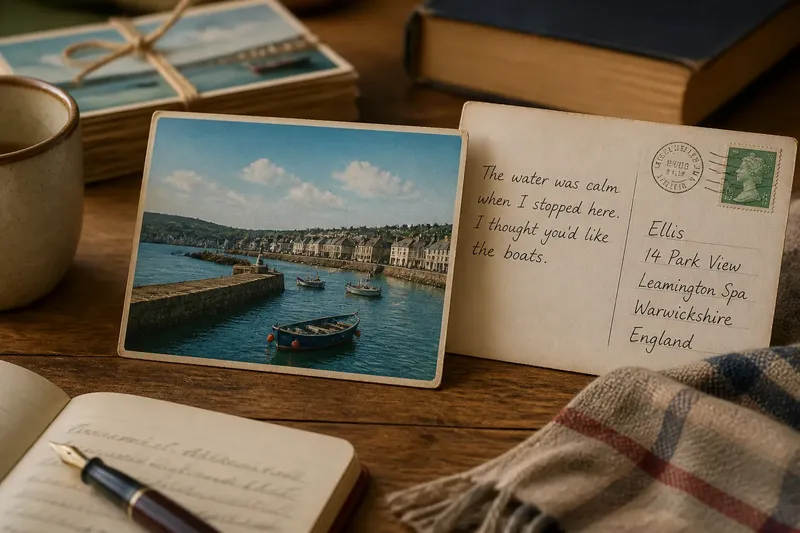
In the image Mara selects, the harbour fills most of the front. A breakwater leads the eye towards the water, while a few boats provide scale. The cropped edges leave out the road behind the photographer and much of the town beyond the shore. Ellis receives a view with a centre, a boundary and an implied direction for looking.
This compactness is useful. Ellis can hold the scene in one hand, set it beside a letter, or keep it in a drawer. The place has become an object that can be revisited without a journey. Unlike a description, the image gives Ellis visible details to inspect: the shape of the shoreline, the arrangement of boats and the contrast between water and buildings.
But a small image cannot carry the conditions of the view in full. It does not tell Ellis where the photographer stood, how long Mara looked at the harbour, or what was happening just beyond the crop. The postcard’s frame is both a convenience and a limit: it makes a scene manageable by leaving much of the place out.
That limit need not make the image misleading. It does mean that the card should be read as a selected view, not as a complete account. Ellis may use it to imagine the town, but the card cannot establish what the whole town looks or feels like.
The message turns a picture into a particular encounter
Mara writes on the reverse: “The water was calm when I stopped here. I thought you’d like the boats.” The words do not describe every visible detail. Instead, they connect the image to her time and attention. “When I stopped here” places a person behind the view; “I thought you’d like” makes the selection a gesture towards Ellis.
The message also changes how the picture is read. Without the writing, Ellis might treat the card as a general souvenir of the harbour. With it, the calm water becomes a remembered condition, and the boats become the reason Mara chose this particular image. The caption is not a full explanation; it is a small guide to the relationship between sender, scene and recipient.
Imagine Mara had written instead, “The wind kept pushing spray over the promenade.” The same calm-looking picture would then sit beside a description of weather that may not be visible in it. Ellis would have two forms of evidence: the printed scene and Mara’s account of being there. Their difference would invite curiosity rather than automatically cancel one or the other.
Handwriting adds another trace. Its size, slant and pressure make the message feel made for one recipient, even when the front image was printed for many. The card therefore combines repetition and particularity: a widely available view on one side, an individual address on the other.
The journey adds distance to the image
After writing, Mara addresses the card and sends it into the post. The postcard now has a practical destination as well as a pictured one. Its route may take it through sorting and delivery before Ellis sees it; the message moves through ordinary systems that connect people who are not together.
That delay changes the encounter. Ellis does not receive the image at the moment Mara sees the harbour. The card arrives later, carrying a scene from a past afternoon into a different setting. The gap can make the picture feel like a small arrival from elsewhere, while the postmark and handwriting give clues to its passage.
When Ellis opens the card at home, the harbour is not physically present. Yet the image can prompt a conversation, a question or a comparison with places Ellis knows. The postcard’s effect comes partly from this crossing between settings: a view selected in one place becomes an object handled and interpreted in another.
Its arrival also makes room for a response. Ellis might keep the card, write back, or refer to the boats in a later conversation. The image can outlast the first exchange, acquiring meaning through how the recipient uses it. A postcard is therefore not only a message moving in one direction; it can become a shared point of reference.
What can a postcard tell its recipient?
Does the image show what the place was really like?
It shows a particular view, reproduced within a particular frame, rather than the entire place. The recipient can observe details in the picture but should treat it as one selected encounter, not a complete description.
Why include a message if the picture already says so much?
The picture gives visible details, while the message can explain why this view mattered to the sender. A short note may connect the scene to a moment, a feeling or a shared interest that the image alone cannot convey.
What changes when the postcard arrives later?
The recipient meets the scene after the sender has left it, so the card carries a trace of an earlier moment into a new place. That delay can make the image a keepsake as well as a message, though the recipient’s reading may differ from the sender’s intention.
Why might two people remember the same postcard differently?
The sender may remember choosing and writing the card, while the recipient remembers where it arrived or what they noticed first. The printed view stays much the same, but each person attaches it to a different experience.
The recipient makes a new use for the view
Say Ellis keeps Mara’s card on a desk because the blue water suits the room. At first, Ellis may look at it as a reminder of Mara’s visit. Later, the card might prompt a question about how harbour towns are arranged, or bring back a conversation about boats. Its use has shifted, even though neither the picture nor the original message has changed.
This imagined outcome shows why a portable image can gather meanings beyond its first purpose. Mara selected the card to share a view; Ellis may keep it as a token of friendship, a source of visual interest or a prompt for another conversation. Those meanings are not all contained in the printed scene. They develop through the recipient’s attention and circumstances.
The shift can also expose what the card cannot answer. Ellis might wonder whether the boats are used for work or leisure, but the image alone may not say. Asking Mara, consulting a map or finding another account would add information from outside the postcard. The card can start an inquiry without resolving it.
What is not worth reading into the card
It is not worth treating a single postcard as proof that a town is picturesque, peaceful or representative of everyone who lives there. A commercial view may favour a striking shoreline, and a sender may choose a scene that suits the recipient rather than one that captures daily life. Those are reasons to ask how the image was selected, not reasons to dismiss it.
Nor does every blank on the reverse need a hidden interpretation. A brief message may simply reflect limited space or the sender’s preference. Reading closely means noticing the postcard’s choices without pretending that each omission has a definite explanation.
In this invented journey, the postcard succeeds because it does several modest things together. It gives Ellis a visible view, lets Mara mark why she chose it, and carries both across a distance. The card does not transport the harbour whole; it makes one framed encounter available to someone who was not there.
That is the useful distinction to keep in mind when a postcard turns up in a drawer: it is evidence of a shared act of looking, not a substitute for the place itself. Its image, message and journey each leave a different trace, and the recipient can notice all three without confusing any one of them for the whole story.